
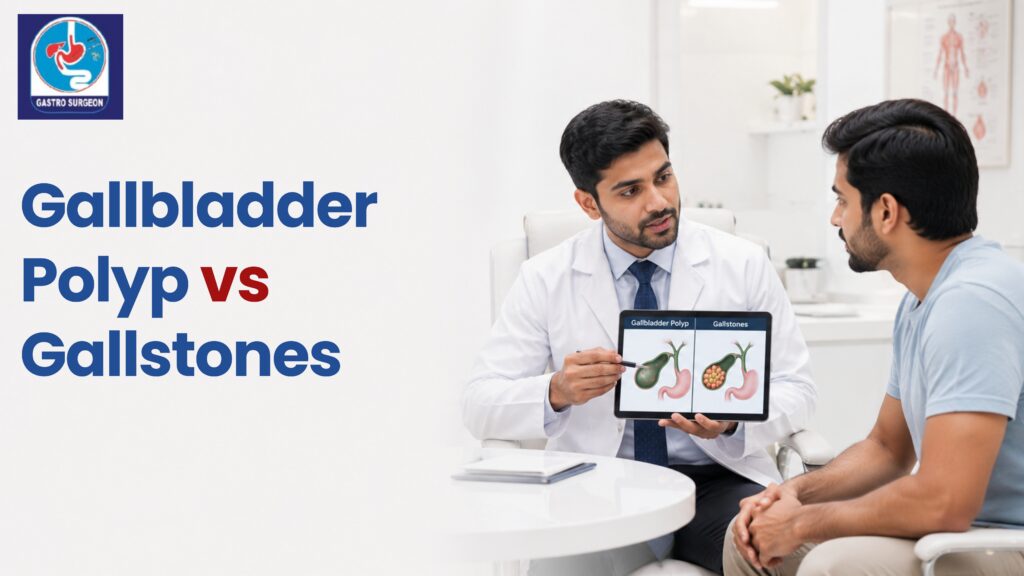
Gallbladder polyps and gallstones are two different conditions that can be discovered during an ultrasound or other abdominal imaging test. Because both involve the gallbladder, patients often assume that they are the same problem. They aren’t.
Understanding the difference between a gallbladder polyp vs gallstone is important because their causes, appearance, risks, and treatment approaches are different. Gallstones are hardened deposits that form within bile, while gallbladder polyps are growths or lesions arising from the inner wall of the gallbladder.
Gallstones are extremely common and may never cause symptoms. Gallbladder polyps are also frequently found incidentally, and most are benign. However, certain gallbladder polyps can carry a risk of malignancy, particularly when they are larger or associated with specific risk factors.
The good news is that modern ultrasound and other imaging techniques can help doctors identify these conditions and decide whether monitoring or surgery is appropriate.
This guide explains gallbladder polyp vs gallstone, including their differences, symptoms, causes, diagnosis, treatment options, cancer risk, and situations in which gallbladder removal may be recommended.
What Is a Gallbladder Polyp?
A gallbladder polyp is a growth or lesion projecting from the inner lining of the gallbladder.
Many gallbladder polyps are discovered accidentally when an abdominal ultrasound is performed for another reason. Most are benign and may not cause any symptoms.
Gallbladder polyps are not all the same. Some represent cholesterol deposits, while others can be inflammatory or adenomatous lesions. Adenomatous polyps are important because some have malignant potential.
The size and characteristics of a polyp are therefore important when determining how it should be managed.
According to the 2022 European joint guidelines, polyp size, symptoms, age, morphology, and other risk factors help determine whether follow-up ultrasound or gallbladder surgery should be considered.
What Is a Gallstone?
A gallstone is a solid deposit that forms inside the gallbladder from substances present in bile.
Gallstones are generally classified as cholesterol stones or pigment stones. They can range from tiny particles to larger stones.
Some people have gallstones for years without experiencing symptoms. These are often called asymptomatic gallstones.
Problems can occur when a stone blocks the gallbladder outlet or bile ducts. This may cause biliary colic, acute cholecystitis, jaundice, pancreatitis, or other complications.
Unlike a gallbladder polyp, a gallstone is a hardened deposit within the gallbladder rather than a growth arising from the gallbladder wall.
Gallbladder Polyp vs Gallstone: Key Differences
The easiest way to understand the difference is to compare their origin and appearance.
| Feature | Gallbladder Polyp | Gallstone |
| What is it? | A growth or lesion from the gallbladder lining | A hardened deposit formed from bile |
| Typical location | Attached to the gallbladder wall | Usually lies within the gallbladder |
| Common symptoms | Often none | Often none unless symptomatic |
| Common detection | Ultrasound | Ultrasound |
| Mobility on ultrasound | Usually attached to the wall and does not move with position | Often moves or produces characteristic acoustic shadowing |
| Main concern | Size and features may indicate malignancy risk | Obstruction, inflammation, or pancreatitis |
| Typical management | Observation or surgery depending on risk | Observation or gallbladder removal when symptomatic/complicated |
This distinction is important because a lesion that looks like a polyp on an initial ultrasound may occasionally represent something else, and imaging findings should be interpreted by an experienced clinician.
What Causes Gallbladder Polyps?
Gallbladder polyps have several possible causes and types.
The most common are cholesterol polyps, which are associated with cholesterol accumulation in the gallbladder wall.
Other possibilities include inflammatory polyps and adenomas.
Some polyps can be associated with chronic gallbladder inflammation or other conditions.
Unlike gallstones, gallbladder polyps are not formed because bile crystallizes into stones.
What Causes Gallstones?
Gallstones develop when the balance of substances in bile changes and solid particles form.
Several factors can increase the risk of gallstones, including obesity, rapid weight loss, pregnancy, increasing age, certain metabolic conditions, family history, and some dietary patterns.
Gallstones may also develop when the gallbladder does not empty normally.
However, having one or more risk factors doesn’t mean that a person will definitely develop gallstones.
Symptoms: Gallbladder Polyp vs Gallstone
One of the biggest differences between the two conditions is how commonly they cause symptoms.
Gallbladder Polyp Symptoms
Most gallbladder polyps don’t cause noticeable symptoms.
When symptoms occur, they may overlap with other gallbladder conditions and can include abdominal discomfort, particularly in the upper right portion of the abdomen.
Because symptoms aren’t specific, imaging is usually needed to identify a polyp.
Gallstone Symptoms
Gallstones can also remain completely asymptomatic.
When a stone blocks the gallbladder outlet, patients may experience biliary colic. This commonly causes pain in the upper right abdomen or upper central abdomen and may occur after meals.
Pain can sometimes spread toward the back or right shoulder.
Nausea and vomiting may accompany an attack.
If fever, jaundice, persistent severe pain, or other concerning symptoms occur, urgent medical evaluation may be necessary.
How Are Gallbladder Polyps and Gallstones Diagnosed?
Ultrasound is usually the first imaging test used to evaluate gallbladder abnormalities.
It can often distinguish between stones and wall-based lesions by assessing their position, movement, and ultrasound characteristics.
Gallstones commonly produce posterior acoustic shadowing and may move when the patient changes position. Polyps generally remain attached to the gallbladder wall.
However, imaging interpretation isn’t always straightforward.
If a lesion is uncertain, a doctor may recommend repeat ultrasound or another imaging technique depending on the circumstances.
The European joint guidelines recommend ultrasound as the primary investigation for gallbladder polyp assessment.
When Is a Gallbladder Polyp Dangerous?
This is one of the most important questions patients ask after receiving an ultrasound report.
Most gallbladder polyps are benign, but some have malignant potential.
Size is one of the major factors. According to the European joint guidelines, cholecystectomy is recommended for gallbladder polypoid lesions measuring 10 mm or more when the patient is fit for surgery and after appropriate assessment.
For smaller polyps, management depends on additional factors.
The guidelines identify risk factors such as age over 60, primary sclerosing cholangitis, Asian ethnicity, and sessile morphology or focal gallbladder wall thickening greater than 4 mm.
Importantly, management recommendations can vary according to clinical circumstances and guidelines. Patients should not assume that every 10 mm lesion automatically means cancer or that every small polyp can be ignored.
When Do Gallstones Need Treatment?
Gallstones don’t always require treatment.
If gallstones are discovered incidentally and the patient has no symptoms, doctors may recommend observation rather than immediate surgery in many cases.
Treatment becomes more relevant when gallstones cause symptoms or complications.
Common indications for medical evaluation include recurrent biliary pain, acute cholecystitis, pancreatitis caused by gallstones, bile duct obstruction, or other complications.
For symptomatic gallstones, laparoscopic cholecystectomy is commonly used to remove the gallbladder.
Treatment of Gallbladder Polyps
Treatment depends mainly on the size, appearance, growth pattern, symptoms, and individual risk factors.
Observation and Follow-Up
Small polyps without concerning features may be monitored with follow-up ultrasound.
The goal is to identify significant growth or changes that could alter management.
Gallbladder Removal
When a polyp has characteristics associated with higher malignancy risk, surgery may be recommended.
The operation is called a cholecystectomy, which removes the gallbladder.
Laparoscopic cholecystectomy is commonly used when surgery is appropriate.
Treatment of Gallstones
Treatment depends on whether the stones cause symptoms or complications.
Observation
Asymptomatic gallstones often don’t require immediate treatment.
Medications
Certain medicines may dissolve selected cholesterol stones in carefully chosen situations, but this approach isn’t suitable for everyone and stones can recur.
Laparoscopic Cholecystectomy
For symptomatic or complicated gallstone disease, laparoscopic gallbladder removal is a widely used treatment.
The procedure involves several small incisions rather than one large abdominal incision.
Patients typically experience less postoperative discomfort and a shorter recovery compared with traditional open surgery when laparoscopic surgery is appropriate.
Can a Gallbladder Polyp Turn Into a Gallstone?
No.
A gallbladder polyp does not transform into a gallstone, and a gallstone does not turn into a polyp.
They are different types of gallbladder abnormalities.
However, both can appear on the same ultrasound examination, and distinguishing between them is important for determining appropriate treatment.
Can Gallbladder Polyps Cause Cancer?
Some gallbladder polyps can be associated with gallbladder cancer, but the majority are benign.
The risk is influenced by factors such as polyp size, morphology, growth, and certain patient characteristics.
This is why doctors don’t simply label every polyp as harmless or dangerous. Instead, they assess the complete clinical and imaging picture.
A larger or suspicious lesion may require surgical evaluation.
Can Gallstones Cause Gallbladder Cancer?
Gallstones are associated with chronic gallbladder inflammation and are a recognized risk factor for gallbladder cancer, although most people with gallstones will never develop cancer.
The presence of gallstones alone does not mean that cancer is present.
Persistent symptoms, abnormal imaging, or other concerning findings should be assessed by a specialist.
Gallbladder Polyp vs Gallstone: Which Is More Serious?
Neither condition can be classified as universally more serious.
An asymptomatic gallstone may never cause a problem, while a large or suspicious gallbladder polyp may require surgical evaluation because of potential malignancy risk.
On the other hand, a gallstone blocking the bile duct can cause a medical emergency.
The seriousness depends on the patient’s symptoms, imaging findings, complications, and risk factors.
When Should You See a Doctor?
You should arrange a medical evaluation if an ultrasound identifies a gallbladder polyp or gallstones, particularly if you have persistent abdominal symptoms.
Seek urgent medical attention for severe or persistent upper abdominal pain accompanied by fever, repeated vomiting, jaundice, confusion, or significant weakness.
These symptoms can indicate gallbladder inflammation, bile duct obstruction, or another condition requiring prompt treatment.
Understanding gallbladder polyp vs gallstone is important because these conditions may look similar on an ultrasound report but have very different implications. Gallstones are hardened deposits formed from bile, while gallbladder polyps are lesions arising from the gallbladder wall.
Most gallstones and many gallbladder polyps are harmless when they don’t cause symptoms or have concerning characteristics. However, symptomatic gallstones may require laparoscopic gallbladder removal, while certain gallbladder polyps may need surgery because of their size, growth, morphology, or associated risk factors.
If your ultrasound report mentions a gallbladder polyp or gallstone, don’t panic. The next step is to discuss the finding with a qualified gastrointestinal or hepatobiliary surgeon who can interpret the imaging and recommend observation, additional testing, or surgery when appropriate.
For patients seeking specialist gastrointestinal and minimally invasive surgical care in Andhra Pradesh, Dr. Ramesh Baipalli is a surgical gastroenterologist known for advanced laparoscopic and gastrointestinal procedures. He is an Outlook Best Doctor 2025 Honoree, has treated 25,000+ patients, and is recognized as a leader in surgical gastroenterology in Andhra Pradesh. His focus on advanced minimally invasive surgery and patient-centered care makes him a notable specialist for patients seeking expert evaluation and treatment for gallbladder polyps, gallstones, and other gastrointestinal conditions.
FAQs
Are gallbladder polyps and gallstones the same?
No. A gallbladder polyp is a growth or lesion arising from the gallbladder lining, whereas a gallstone is a hardened deposit formed from bile.
Are gallbladder polyps dangerous?
Most are benign, but some polyps have malignant potential. Size, morphology, growth, age, and other risk factors help determine the appropriate management.
Do all gallbladder polyps require surgery?
No. Many small, low-risk polyps can be monitored with ultrasound. Surgery may be recommended when specific risk factors or suspicious features are present.
Do all gallstones require surgery?
No. Many people with asymptomatic gallstones don’t require immediate treatment. Surgery is generally considered when stones cause symptoms or complications.