
Choosing the right surgeon is one of the most important decisions when you need hernia mesh surgery in Vizag. While hernia repair is a common surgical procedure, successful treatment involves much more than simply placing a mesh.
The surgeon must accurately diagnose the type and location of the hernia, assess its size and complexity, select an appropriate repair technique, choose suitable mesh when indicated, and ensure that the repair is performed safely.
With several hospitals and surgeons offering hernia treatment in Visakhapatnam, patients may find it difficult to determine whom to trust.
This guide explains the key factors to consider when choosing a hernia mesh surgeon in Vizag, what questions to ask during consultation, and what to know about modern hernia repair.
What Is Hernia Mesh Surgery?
A hernia occurs when an internal organ or tissue pushes through a weakened area of muscle or connective tissue. Common examples include inguinal hernia, umbilical hernia, incisional hernia, femoral hernia, and ventral hernia.
During hernia repair, the surgeon returns the protruding tissue to its appropriate position and closes or reinforces the weakened area.
In many adult hernia repairs, a surgical mesh may be used to reinforce the abdominal wall. Mesh can provide additional strength and may reduce the likelihood of recurrence in appropriate repairs.
However, mesh is not required for every hernia or every patient. The decision depends on factors such as hernia type, size, location, patient characteristics, surgical technique, and the surgeon’s assessment.
Why Choosing the Right Hernia Surgeon Matters
A hernia may appear straightforward from the outside, but the underlying anatomy can be complex.
An experienced hernia surgeon should be able to identify the relevant anatomy, recognize potential risk factors, select an appropriate repair method, and manage complications if they occur.
The quality of the repair can depend on several factors, including accurate diagnosis, surgical technique, appropriate mesh selection, mesh positioning, fixation when required, and postoperative care.
Therefore, instead of searching only for the “best hernia surgeon near me,” consider whether the surgeon has the qualifications and experience relevant to your particular type of hernia.
Check the Surgeon’s Qualifications
Start by reviewing the surgeon’s educational background, specialist qualifications, and areas of surgical training.
For complex abdominal-wall conditions, a surgeon with specialist training in general surgery, gastrointestinal surgery, laparoscopic surgery, or surgical gastroenterology may have relevant expertise.
Professional memberships, fellowships, continuing surgical education, and hospital affiliations can also provide useful information.
However, qualifications should be considered alongside actual experience with the procedure you may require.
Look for Experience in Hernia Surgery
Experience matters because hernias are not all the same.
A surgeon who routinely performs hernia repairs may be familiar with different approaches, including open repair and minimally invasive procedures such as laparoscopic hernia surgery.
Ask how frequently the surgeon performs the type of hernia repair being recommended.
For example, the considerations for an uncomplicated inguinal hernia can differ significantly from those for a recurrent hernia, large ventral hernia, or incisional hernia after previous abdominal surgery.
Understand the Recommended Surgical Technique
There are several ways to repair a hernia.
Open Hernia Repair
Open repair is performed through an incision directly over or near the hernia. The surgeon repairs the defect and may reinforce the abdominal wall with mesh.
Open surgery remains an important option and can be appropriate for many patients.
Laparoscopic Hernia Repair
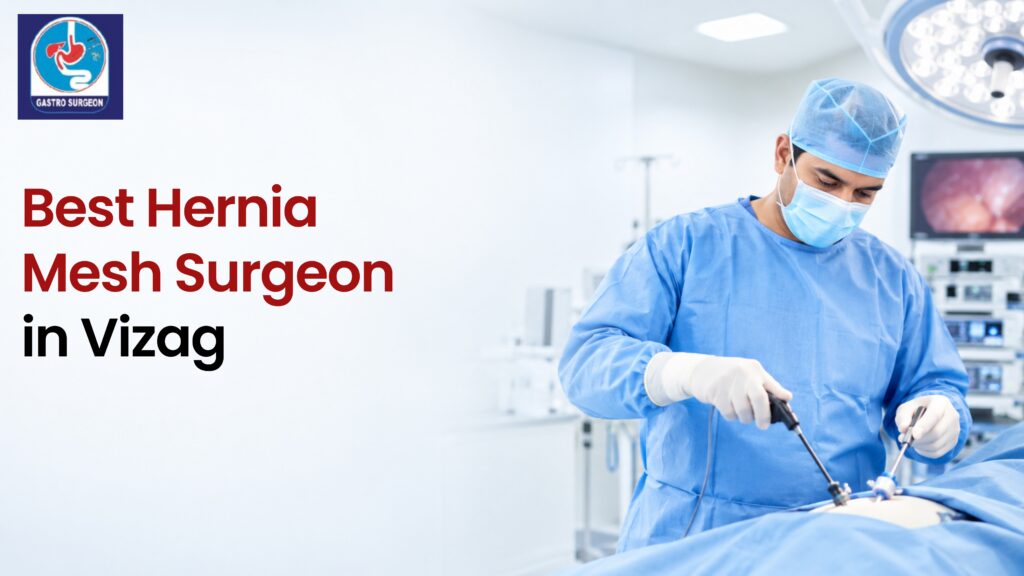
Laparoscopic repair uses small abdominal incisions and a camera. Specialized instruments are used to place mesh and reinforce the weakened area.
For selected patients, minimally invasive repair can offer advantages such as smaller incisions and potentially less early postoperative discomfort.
Robotic Hernia Repair
Robotic-assisted hernia surgery uses a robotic surgical platform controlled by the surgeon. It may offer enhanced visualization and instrument articulation and can be useful in selected complex cases.
Robotic surgery is not automatically superior for every patient. The appropriate approach depends on the hernia, patient factors, surgeon expertise, and available facilities.
Ask Which Mesh Is Being Recommended
“Mesh” is not one single product.
Surgical meshes differ in material, structure, weight, pore size, coating, and other characteristics. Different meshes may be selected for different clinical situations.
Ask your surgeon:
- Why is mesh recommended for my hernia?
- Which type of mesh will be used?
- Where will the mesh be positioned?
- How will it be fixed, if fixation is necessary?
- What are the potential benefits and complications?
Your surgeon should be able to explain the reasoning behind the recommendation in language you can understand.
Ask About Mesh Placement
Mesh position can be an important part of hernia repair.
Depending on the type of hernia and surgical approach, mesh can be positioned in different anatomical planes.
Correct placement and adequate overlap of the hernia defect are important technical considerations.
Patients should not assume that the most expensive mesh or newest mesh is necessarily the best choice. The appropriate product and placement depend on the individual repair.
Consider the Surgeon’s Approach to Complications
Every operation carries potential risks.
Hernia repair complications can include infection, bleeding, fluid collection, nerve-related symptoms, chronic pain, recurrence, and injury to nearby structures.
Although uncommon, mesh-related complications can also occur.
A responsible surgeon should discuss potential complications before surgery rather than presenting hernia repair as completely risk-free.
Ask how complications are monitored and managed and what symptoms should prompt you to contact the hospital after surgery.
Ask About Recurrence
One of the main goals of hernia surgery is to provide a durable repair.
However, hernia recurrence can occur even after technically successful surgery.
Risk can be influenced by factors such as hernia characteristics, surgical technique, smoking, obesity, wound complications, connective-tissue factors, and other patient-specific considerations.
A good surgeon should explain your individual recurrence risk rather than promise that recurrence is impossible.
Evaluate the Hospital and Surgical Facilities
The surgeon is important, but so is the facility where the operation will take place.
Consider whether the hospital has appropriate operating-room infrastructure, anesthesia support, trained nursing staff, postoperative monitoring, emergency services, and access to diagnostic facilities.
For laparoscopic or robotic procedures, ask whether the hospital has the necessary equipment and whether the surgical team routinely uses it.
Don’t Choose a Surgeon Based Only on Price
Hernia surgery cost in Vizag can vary depending on the type of hernia, surgical technique, hospital, surgeon, mesh used, anesthesia, room category, investigations, and postoperative care.
A very low quoted price may not include every component of treatment.
Before comparing prices, ask for a detailed estimate that specifies whether surgeon fees, mesh, anesthesia, operating-room charges, hospitalization, medicines, investigations, and follow-up visits are included.
Cost is an important consideration, but it should not be the only criterion for choosing a surgeon.
Look for Clear Communication
A good consultation should leave you with a clear understanding of your condition and treatment options.
Your surgeon should explain:
- What type of hernia you have.
- Whether surgery is necessary now.
- Which repair technique is recommended.
- Whether mesh is appropriate.
- The expected benefits and potential risks.
- Recovery and activity restrictions.
- Estimated treatment costs.
You should also have an opportunity to ask questions.
If you leave the consultation still unsure about what procedure is being recommended or why mesh is being used, consider asking for clarification before proceeding.
Questions to Ask a Hernia Mesh Surgeon in Vizag
Before scheduling surgery, consider asking the following:
What type of hernia do I have?
Understanding the diagnosis is the starting point for evaluating treatment.
Do I definitely need surgery?
Some minimally symptomatic hernias, particularly certain inguinal hernias, may be managed with observation in selected patients. Your surgeon can explain whether watchful waiting is reasonable in your situation.
Why are you recommending mesh?
Mesh is frequently used in adult hernia repair, but its use should be individualized.
Which surgical approach is best for me?
Ask whether open, laparoscopic, or robotic repair is appropriate and why.
What is my expected recovery time?
Recovery depends on the operation, hernia complexity, occupation, overall health, and individual healing.
What complications should I watch for?
Knowing warning signs can help you seek medical care promptly when necessary.
Warning Signs That a Hernia May Need Urgent Attention
Not every hernia is an emergency, but certain symptoms can indicate incarceration or strangulation.
Seek urgent medical assessment if a hernia suddenly becomes extremely painful, firm, swollen, or cannot be pushed back when it previously could. Severe abdominal pain, vomiting, abdominal swelling, fever, or difficulty passing stool or gas can also be concerning.
Do not attempt to repeatedly force a painful or firm hernia back into the abdomen.
Prompt medical evaluation can be particularly important when symptoms develop suddenly or worsen rapidly.
Preparing for Hernia Surgery
Once surgery has been recommended, your surgeon may provide instructions regarding medications, fasting, smoking, diabetes control, weight management, and other health factors.
If you smoke, ask your healthcare provider about stopping before surgery because smoking can impair wound healing and may increase surgical complications.
Patients with obesity may also benefit from discussing weight management before elective hernia surgery when clinically appropriate.
Your surgeon will provide individualized instructions based on your health and planned procedure.
Recovery After Hernia Mesh Surgery
Recovery varies depending on whether the repair is open, laparoscopic, or robotic and whether the hernia is simple or complex.
Patients may experience soreness, bruising, swelling, or fatigue during the early recovery period.
Walking is often encouraged as tolerated, while strenuous activity and heavy lifting may be restricted for a period determined by the surgeon.
Follow-up appointments allow the surgical team to assess healing and address concerns such as persistent pain, swelling, wound problems, or other symptoms.
Do not return to heavy exercise simply because the incision appears healed. Follow your surgeon’s specific activity recommendations.
Choosing the best hernia mesh surgeon in Vizag should involve more than comparing advertisements, online ratings, or surgical prices. The most important considerations include the surgeon’s qualifications, experience with your specific type of hernia, understanding of modern repair techniques, appropriate mesh selection, hospital facilities, communication, and postoperative support.
Before surgery, ask why mesh is recommended, which surgical technique is appropriate, what the expected recovery will involve, what complications are possible, and what the complete treatment cost includes.
Most importantly, remember that the “best” hernia repair is not necessarily the newest or most expensive procedure. It is the approach that is appropriately selected and safely performed for your individual condition by a qualified surgical team.
Dr. Ramesh Baipalli is a surgical gastroenterologist in Visakhapatnam. According to his professional profile, he is an “Outlook Best Doctor 2025 Honoree,” has treated 25,000+ patients, and is recognized as a leader in surgical gastroenterology in Andhra Pradesh. Patients considering hernia mesh surgery can consult a qualified specialist to receive an individualized assessment and understand the most appropriate repair options for their condition
FAQs
Is mesh safe for hernia surgery?
Surgical mesh is widely used in hernia repair and can strengthen the abdominal wall in appropriate patients. However, mesh can have complications, including infection, chronic pain, and recurrence. The decision to use mesh should be based on the individual case.
Is laparoscopic hernia surgery better than open surgery?
Neither approach is universally better. Laparoscopic repair may provide advantages for selected patients, while open repair can be appropriate in many situations. The best technique depends on the hernia and the patient’s circumstances.
How do I find the best hernia surgeon in Vizag?
Look for appropriate specialist qualifications, substantial experience with hernia repair, familiarity with different surgical techniques, good hospital facilities, transparent communication, and a treatment plan tailored to your diagnosis.
How much does hernia mesh surgery cost in Vizag?
There is no single fixed price. Cost depends on hernia type, surgical technique, mesh, hospital, surgeon, anesthesia, investigations, room category, and postoperative care. Request a detailed estimate before surgery.
Can a hernia be treated without surgery?
Some minimally symptomatic hernias may be monitored under medical guidance. However, a hernia that causes significant symptoms, enlarges, becomes difficult to reduce, or develops emergency symptoms may require surgical treatment.