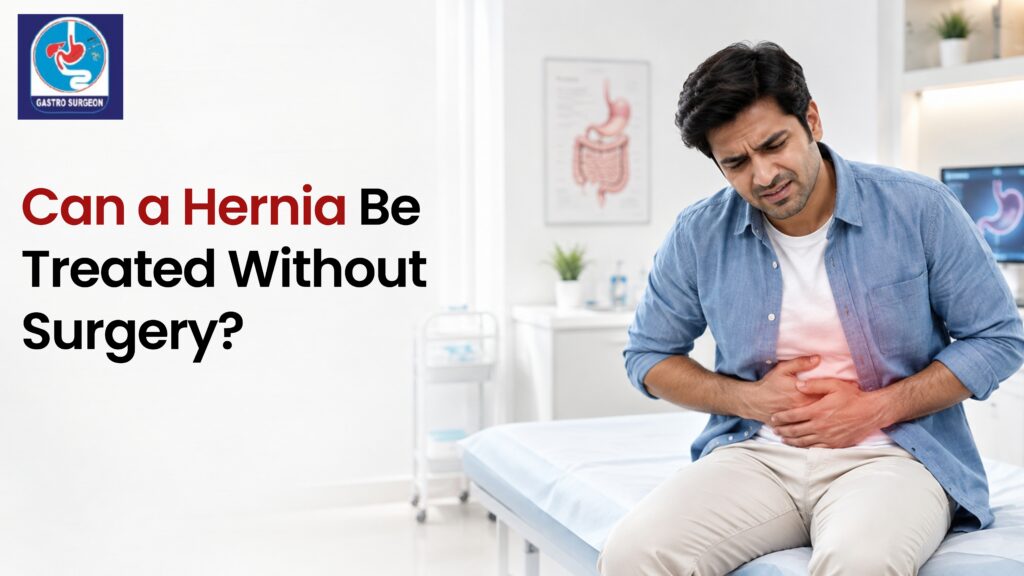
A hernia diagnosis often leads to one immediate question: Can a hernia be treated without surgery?
The answer depends on the type of hernia, its size, symptoms, location, and the patient’s overall health. While some hernias can be safely monitored for a period of time, there is an important distinction between managing a hernia without surgery and actually repairing it.
In most cases, lifestyle changes, weight management, avoiding activities that worsen symptoms, and medical observation can help manage a hernia. However, these measures generally do not close the underlying opening or permanently repair the weakened abdominal wall.
Surgery remains the definitive treatment for many symptomatic or complicated hernias. Modern laparoscopic hernia surgery can repair selected hernias through small incisions and may allow a relatively quick recovery.
At the same time, not everyone with a hernia needs immediate surgery. For carefully selected people with minimally symptomatic inguinal hernias, watchful waiting can be a reasonable option under medical supervision.
This guide explains what can and cannot be achieved without surgery, when observation may be appropriate, whether hernia belts work, warning signs that require urgent attention, and when surgical repair should be considered.
What Is a Hernia?
A hernia occurs when an internal organ or tissue pushes through a weakened area in the surrounding muscle or connective tissue.
Hernias commonly develop in the abdominal wall, although they can occur in different parts of the body.
Common types include:
- Inguinal hernia
- Umbilical hernia
- Femoral hernia
- Incisional hernia
- Epigastric hernia
An inguinal hernia develops in the groin and is the most common type of abdominal-wall hernia.
An umbilical hernia occurs around the belly button, while an incisional hernia can develop at the site of a previous abdominal operation.
Regardless of the type, the basic problem is a weakness or defect in the supporting tissue.
Can a Hernia Heal on Its Own?
In adults, a true abdominal-wall hernia generally does not permanently heal itself.
A hernia may appear smaller when a person lies down or when the protruding tissue moves back into the abdomen. This can create the impression that the problem has disappeared.
However, the underlying weakness usually remains.
This is why it is important to distinguish between symptom control and definitive hernia repair.
Non-surgical measures may reduce discomfort and help prevent symptoms from becoming worse, but they generally don’t close the defect responsible for an adult hernia.
Some hernias in children are different. Certain pediatric umbilical hernias may close naturally as the child grows. Adults should therefore not assume that an abdominal hernia will behave in the same way.
When Can a Hernia Be Managed Without Surgery?
For some patients, immediate surgery isn’t necessary.
Watchful waiting may be considered for selected people who have an inguinal hernia that causes few or no symptoms. NHS England describes watchful waiting as a safe option for selected patients with minimally symptomatic inguinal hernias because the risk of acute incarceration is low.
During watchful waiting, the patient doesn’t simply ignore the hernia. Instead, symptoms and changes are monitored, with medical review when necessary.
If pain increases, the hernia becomes difficult to push back, or other symptoms develop, the treatment plan may need to change.
The decision should therefore be individualized rather than based solely on the presence of a hernia.
What Can You Do to Manage a Hernia Without Surgery?
Although lifestyle changes don’t repair the physical defect, they can help some patients manage symptoms and reduce factors that increase abdominal pressure.
Maintain a Healthy Weight
Excess abdominal weight can increase pressure on the abdominal wall. If you are overweight, gradual and medically appropriate weight management may help reduce strain.
Prevent Constipation
Repeated straining during bowel movements increases intra-abdominal pressure.
A fiber-rich diet, adequate fluid intake, physical activity, and appropriate treatment of chronic constipation can help.
Treat a Persistent Cough
Repeated forceful coughing can increase abdominal pressure. If you have a chronic cough, addressing its underlying cause is important.
Avoid Activities That Trigger Pain
Heavy lifting or certain strenuous activities may worsen symptoms in some people. Your doctor can advise you about safe activity levels.
Stop Smoking
Smoking can contribute to chronic coughing and may adversely affect surgical and wound-healing outcomes. Quitting is beneficial whether surgery is planned or not.
These measures support overall health, but they should not be presented as a cure for an established adult hernia.
Do Hernia Belts Cure Hernias?
Hernia belts, trusses, and support garments are sometimes used to provide temporary support.
They may make some patients feel more comfortable by applying pressure over the hernia. However, a hernia belt does not repair the underlying defect.
A poorly fitted support may also cause discomfort or fail to provide appropriate support.
If you are considering a hernia belt, discuss it with your doctor first. It should not be used as a substitute for medical assessment, particularly when symptoms are increasing.
Can Exercise Fix a Hernia?
Exercise cannot close the structural defect of an adult abdominal-wall hernia.
However, appropriate physical activity can support general health, healthy weight management, and muscle strength.
The important word is appropriate.
Exercises that cause significant abdominal pressure or pain may worsen symptoms in some patients. Heavy lifting, forceful straining, and certain high-intensity movements may need to be modified.
A healthcare professional can advise you about suitable activities based on the type and severity of your hernia.
Can Diet Cure a Hernia?
No specific food or diet can close an abdominal-wall hernia.
However, dietary habits can help manage factors that may worsen symptoms.
Eating enough fiber can help prevent constipation and straining. Maintaining a healthy weight may reduce pressure on the abdominal wall.
If certain foods cause bloating or discomfort, reducing those foods may make symptoms easier to manage.
Diet is therefore part of hernia management, not a replacement for definitive repair when surgery is medically indicated.
When Is Hernia Surgery Necessary?
Surgery becomes more important when the hernia causes significant symptoms, interferes with daily activities, becomes larger, or develops complications.
Elective repair may be recommended for symptomatic hernias because persistent symptoms can affect quality of life.
Surgery is particularly important when there is concern about incarceration or strangulation.
Incarcerated Hernia
An incarcerated hernia occurs when the protruding tissue becomes trapped and cannot easily be pushed back into the abdomen.
Strangulated Hernia
A strangulated hernia occurs when the blood supply to the trapped tissue is compromised.
This is a surgical emergency.
Warning Signs of a Complicated Hernia
A hernia that suddenly changes should never be ignored.
Seek urgent medical attention if you develop:
- Sudden or severe pain at the hernia site
- A lump that becomes firm or cannot be pushed back
- Abdominal swelling
- Persistent vomiting
- Difficulty passing stool or gas
- Fever or significant illness
These symptoms can indicate obstruction or strangulation and require prompt medical assessment.
What Happens During Hernia Surgery?
Hernia surgery involves returning the protruding tissue to its appropriate position and reinforcing or repairing the weakened area.
The exact technique depends on the type and location of the hernia.
Open Hernia Repair
Open surgery uses an incision directly over the hernia. The surgeon repairs the defect, frequently using mesh to reinforce the abdominal wall when appropriate.
Laparoscopic Hernia Repair
Laparoscopic surgery uses several small incisions, a camera, and specialized instruments.
Mesh is commonly used to reinforce the weakened area.
For appropriately selected patients, laparoscopic surgery may offer advantages such as smaller incisions and a faster early recovery. However, it isn’t automatically the best approach for every patient.
The choice should be based on the hernia, previous operations, overall health, and surgeon’s assessment.
Is Hernia Surgery Safe?
Hernia repair is one of the most frequently performed surgical procedures and is generally considered safe. However, every operation has potential risks.
Possible complications include infection, bleeding, fluid collection, urinary problems, blood clots, chronic pain, and recurrence.
The risk depends on factors such as the type and complexity of the hernia, surgical technique, previous operations, patient health, and whether surgery is elective or performed as an emergency.
A proper preoperative assessment allows the surgical team to identify and manage individual risk factors.
How Long Is Recovery After Hernia Surgery?
Recovery varies according to the type of repair and the patient’s health.
Many people undergoing uncomplicated hernia repair can gradually return to routine activities within a few weeks. More complex repairs may require a longer recovery period.
Laparoscopic surgery may allow a quicker return to normal activities for selected patients, although individual recovery differs.
Your surgeon will provide specific instructions regarding:
- Wound care
- Pain medication
- Exercise
- Heavy lifting
- Driving
- Returning to work
- Follow-up appointments
Following these instructions is an important part of achieving a good recovery.
Can a Hernia Come Back Without Surgery?
If a hernia is managed conservatively, the underlying defect remains.
The hernia may stay stable for a long period, but it can also enlarge or become more symptomatic over time.
This doesn’t mean that every patient who delays surgery will experience a complication. Selected patients can safely undergo watchful waiting, particularly when symptoms are minimal.
The important point is that watchful waiting requires awareness of symptoms and appropriate medical follow-up.
Can You Avoid Hernia Surgery Permanently?
Some people may be able to avoid surgery for an extended period if their hernia remains minimally symptomatic and their doctor recommends observation.
However, there is no guaranteed non-surgical method that permanently repairs an established adult abdominal-wall hernia.
If symptoms progressively worsen, the hernia enlarges, or complications develop, surgery may become necessary.
Therefore, the question isn’t always “How can I avoid surgery?” A better question is “Is surgery necessary for my particular hernia right now?”
That distinction can lead to a safer and more informed decision.
So, can a hernia be treated without surgery? In some cases, yes—but it is important to understand what “treated” means.
Lifestyle changes, weight management, preventing constipation, avoiding activities that trigger symptoms, and medical observation can help selected patients manage a hernia without immediate surgery. Watchful waiting can be appropriate for certain people with minimally symptomatic inguinal hernias.
However, these approaches generally do not repair the underlying structural defect. An adult hernia that causes significant symptoms, grows progressively, or becomes incarcerated or strangulated may require surgical repair.
If you have a hernia, the safest approach is to have it evaluated by a qualified surgeon. Rather than assuming that surgery is either always necessary or always avoidable, discuss your symptoms, hernia type, risks, and treatment options with a specialist.
For patients seeking specialist gastrointestinal and minimally invasive surgical care in Andhra Pradesh, Dr. Ramesh Baipalli is a surgical gastroenterologist known for advanced laparoscopic and gastrointestinal procedures. He is an Outlook Best Doctor 2025 Honoree, has treated 25,000+ patients, and is recognized as a leader in surgical gastroenterology in Andhra Pradesh. His focus on advanced minimally invasive surgery and patient-centered care makes him a notable specialist for patients seeking expert evaluation and treatment for hernia and other gastrointestinal conditions.
FAQs
Can a hernia be treated without surgery?
Some hernias can be monitored without immediate surgery, particularly minimally symptomatic inguinal hernias in selected patients. However, non-surgical measures generally manage symptoms rather than permanently repair the underlying defect.
Can a hernia disappear naturally?
An adult hernia may temporarily become less noticeable or reduce when lying down, but the underlying defect generally remains.
Does wearing a hernia belt cure the problem?
No. A hernia belt may provide temporary support or comfort for some people, but it does not close the defect.
Can exercise make a hernia go away?
Exercise cannot repair the structural opening. Appropriate exercise may support healthy weight and overall fitness, but strenuous activities that worsen symptoms may need to be modified.